

Keeping your dog mentally active is crucial for their overall well-being. Just like humans, dogs need mental stimulation to prevent boredom and stress. Engaging your dog’s mind with indoor games can help improve their cognitive function and strengthen your bond.
Indoor games provide an excellent way to challenge your dog’s mind, especially during inclement weather or when outdoor activities are limited. By incorporating cognitive enrichment into your daily routine, you can help keep your dog’s mind sharp and active.
Key Takeaways
- Mental stimulation is essential for a dog’s overall health.
- Indoor games can help reduce boredom and stress in dogs.
- Cognitive enrichment activities strengthen the bond between dog and owner.
- Engaging indoor games can improve a dog’s cognitive function.
- Regular mental stimulation can help prevent behavioral problems.
The Importance of Mental Exercise for Dogs
Engaging your dog’s mind is just as important as exercising their body. Mental stimulation plays a vital role in maintaining your dog’s overall health and happiness. By incorporating mental exercises into your dog’s daily routine, you can help prevent behavioral issues and strengthen your bond with them.
Understanding Canine Cognitive Health
Canine cognitive health refers to a dog’s ability to process information, learn, and remember. As dogs age, their cognitive functions can decline, leading to issues such as confusion and anxiety. Engaging your dog in brain games for dogs and interactive toys for dogs can help maintain their cognitive health.
| Cognitive Function | Description | Benefit of Mental Exercise |
|---|---|---|
| Memory | The ability to recall commands and tasks | Improved memory retention |
| Problem-Solving | The ability to figure out puzzles and challenges | Enhanced problem-solving skills |
| Learning | The ability to learn new commands and behaviors | Faster learning and adaptation |
Preventing Behavioral Problems Through Mental Stimulation
Dogs that lack mental stimulation often develop behavioral problems such as destructive chewing, excessive barking, and digging. Providing mental exercises for dogs can redirect their energy into positive activities. Engaging your dog in puzzle toys and interactive games can keep them occupied and reduce the likelihood of undesirable behaviors.
Balance Between Physical and Mental Exercise
A balanced routine that includes both physical and mental exercise is essential for a dog’s overall well-being. While physical exercise keeps your dog fit, mental stimulation keeps their mind sharp. Combining both aspects can lead to a happier, healthier dog. For example, a game of fetch can be followed by a puzzle toy to challenge their problem-solving skills.
Signs Your Dog Needs More Mental Stimulation
If you’ve noticed your dog being destructive, barking excessively, or just seeming lethargic, it might be time to boost their mental stimulation. Dogs require mental exercise just as much as physical activity to stay healthy and happy.
Destructive Behaviors and Their Causes
Destructive behaviors such as chewing furniture or digging up the yard can be signs that your dog is not getting enough mental stimulation. These actions are often a result of boredom or excess energy. Providing mental stimulation activities can help redirect this energy into more positive outlets.
Excessive Barking and Restlessness
Excessive barking and restlessness are other indicators that your dog might be lacking in mental stimulation. Dogs need challenges to keep their minds engaged. Without these, they may resort to barking or pacing due to boredom or frustration.
Depression and Lethargy in Under-Stimulated Dogs
On the other end of the spectrum, some dogs may become depressed or lethargic if they’re not mentally stimulated. This can manifest as a lack of interest in activities they once enjoyed or simply lying around more than usual. Increasing mental stimulation can help improve their mood and overall mental health.
Recognizing these signs early can help you take the necessary steps to ensure your dog leads a happier, healthier life. Incorporating mental stimulation activities into their daily routine can make a significant difference.
Puzzle Games: Challenge Your Pup’s Problem-Solving Skills
Puzzle games offer a fun and interactive way to challenge your dog’s cognitive abilities and keep them mentally active. These games are designed to test your dog’s problem-solving skills, providing mental stimulation and rewarding them with treats when they succeed.
Store-Bought Puzzle Toys Worth the Investment
Investing in store-bought puzzle toys can be a great way to start challenging your dog’s mind. Brands like Kong and Outward Hound offer a variety of puzzle toys that cater to different skill levels and dog sizes. These toys are designed to be durable and engaging, keeping your dog occupied for extended periods.
Some popular options include:
- Kong Wobbler: A weighted toy that requires problem-solving to get treats out.
- Outward Hound Brick Puzzle: A sliding puzzle that hides treats behind bricks.
DIY Puzzle Games Using Household Items
Creating DIY puzzle games using household items is not only cost-effective but also allows you to customize the difficulty level and type of challenge. Simple items like cardboard boxes, muffin tins, and plastic bottles can be turned into engaging puzzles.
For example, you can create a simple puzzle by:
- Cutting holes of varying sizes in a cardboard box.
- Placing treats inside the box.
- Encouraging your dog to figure out how to get the treats out.
Advancing Difficulty Levels as Your Dog Learns
As your dog becomes more proficient at solving puzzles, it’s essential to increase the difficulty level to keep them challenged. This can be done by introducing new puzzle toys or modifying existing DIY puzzles to make them more complex.
A table outlining the progression of puzzle difficulty is shown below:
| Difficulty Level | Puzzle Description | Dog’s Skill Level |
|---|---|---|
| Easy | Simple treat dispenser | Beginner |
| Medium | Sliding puzzle | Intermediate |
| Hard | Multi-step puzzle | Advanced |
By gradually increasing the difficulty level, you can keep your dog engaged and mentally stimulated, preventing boredom and related behavioral issues.
Scent Work Games for Natural Instincts
Dogs have a remarkable sense of smell, and scent work games are a great way to utilize this natural ability for mental enrichment. These activities not only challenge your dog’s sense of smell but also provide a fun and engaging way to keep them mentally stimulated.
The “Find It” Game and Variations
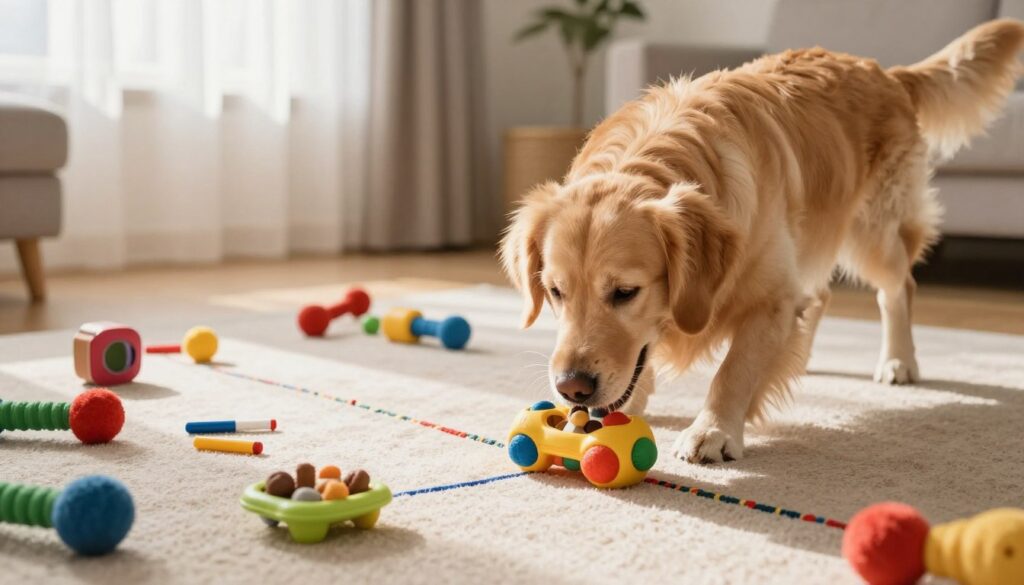
The “Find It” game is a simple yet effective way to engage your dog’s sense of smell. Start by hiding treats or toys with a strong scent around the house or yard, encouraging your dog to use their nose to find them. As your dog becomes more proficient, you can increase the difficulty by using less potent scents or hiding items in harder-to-reach locations.
Variations of the game can include using different types of scents, such as essential oils, or incorporating multiple scents to challenge your dog further. This game not only provides mental stimulation but also strengthens the bond between you and your dog.
Creating Scent Trails Around Your Home
Creating scent trails is another engaging scent work activity. By dragging a treat or toy with a strong scent along a path, you can create a trail for your dog to follow. This activity mimics hunting behaviors, providing your dog with a sense of accomplishment and satisfaction.
To make this activity more challenging, you can create complex trails with multiple turns or hide the treat at the end of the trail, requiring your dog to use their problem-solving skills in addition to their sense of smell.
Food-Based Scent Games for Mealtime Enrichment
Food-based scent games are an excellent way to make mealtime more engaging. By hiding your dog’s meal in various locations or using interactive feeders that require your dog to work for their food, you can turn mealtime into a mentally stimulating activity.
These games not only slow down eating but also provide mental stimulation, reducing boredom and stress. You can also freeze treats or use puzzle toys filled with your dog’s favorite food to increase the challenge.
| Scent Work Activity | Benefits | Tips for Implementation |
|---|---|---|
| The “Find It” Game | Mental stimulation, strengthens bond | Start with strong scents, increase difficulty over time |
| Creating Scent Trails | Mimics hunting behavior, problem-solving | Use treats or toys with strong scents, create complex trails |
| Food-Based Scent Games | Slows down eating, mental stimulation | Use interactive feeders, hide meals, freeze treats |
Training Games That Boost Mental Agility
Dogs need mental stimulation to prevent boredom and stress, and training games offer a fun and interactive way to provide it. Engaging your dog in various training activities not only enhances their cognitive abilities but also strengthens your bond with them.
Teaching New Commands and Tricks Indoors
Teaching new commands and tricks is an excellent way to challenge your dog’s mind. Start with simple commands like “sit,” “stay,” and “shake,” and gradually move on to more complex tricks. Using positive reinforcement techniques, such as treats and praise, can make the learning process enjoyable for your dog.
- Begin with short training sessions and gradually increase the duration.
- Use a variety of commands to keep the training interesting.
- Be patient and consistent in your training approach.
Name Recognition for Toys and Objects
Teaching your dog to recognize the names of their toys and other objects can significantly enhance their cognitive abilities. Start by selecting a few toys and giving them distinct names. Encourage your dog to fetch the toy by name, and reward them when they successfully identify the correct toy.
Tips for successful name recognition:
- Start with one toy and gradually introduce more.
- Use consistent names for the toys.
- Reward your dog with treats and praise for correct identification.
Indoor Agility and Obstacle Courses
Creating an indoor agility course is a great way to challenge your dog physically and mentally. You can use household items like chairs, tunnels, and cones to set up a course. Guide your dog through the course, and as they become more confident, you can time them to add an extra level of challenge.
Benefits of indoor agility courses include:
- Improved physical fitness.
- Enhanced mental agility.
- Strengthened bond between you and your dog.
By incorporating these training games into your dog’s routine, you can provide them with the mental stimulation they need to stay happy and healthy.
Interactive Play: Bonding Games for You and Your Dog
Engaging in interactive play with your dog is a great way to strengthen your bond and keep them mentally active. Interactive games not only provide entertainment but also stimulate your dog’s mind, reducing the likelihood of boredom and related behavioral issues.
One of the simplest yet most effective interactive games is Hide and Seek. This game encourages your dog to use their sense of smell and problem-solving skills to find you or a hidden object.
Hide and Seek: Rules and Variations
To play Hide and Seek, start by having your dog sit and stay, then hide somewhere in the house. Encourage your dog to find you by calling out or using a specific command. As your dog becomes more proficient, you can increase the difficulty by hiding in harder-to-reach places or using multiple hiding spots.
Variations of Hide and Seek include hiding treats or toys, which adds an extra layer of challenge and reward for your dog.
The Shell Game and Other Concentration Activities
The Shell Game is another engaging activity that challenges your dog’s concentration. It involves hiding a treat under one of several cups or shells and shuffling them around. Your dog must then identify which cup or shell the treat is under.
This game enhances your dog’s problem-solving skills and hand-eye coordination. You can make it more challenging by increasing the number of cups or shells and the speed at which you shuffle them.
Tug of War with Training Elements
Tug of War is a classic game that can be adapted to include training elements. By incorporating commands like “drop it” and “take it,” you can turn a simple game into a valuable training session.
This not only strengthens your bond with your dog but also reinforces good behavior and obedience. Make sure to use a sturdy toy that can withstand the tug-of-war, and always be gentle to avoid any accidental harm.
| Game | Description | Benefits |
|---|---|---|
| Hide and Seek | Hide and encourage your dog to find you or a hidden object. | Improves sense of smell and problem-solving skills. |
| The Shell Game | Hide a treat under one of several cups or shells and shuffle them. | Enhances concentration and problem-solving skills. |
| Tug of War | Play Tug of War with your dog, incorporating training commands. | Strengthens bond, reinforces obedience, and promotes good behavior. |
Quiet Games for Apartment Living and Rainy Days
Keeping your dog mentally active doesn’t require a large backyard; quiet games can be just as effective. For dog owners living in apartments, it’s essential to find activities that are not only fun but also considerate of noise levels. Mental stimulation is crucial for maintaining your dog’s overall well-being, especially in environments with limited space.
Silent Enrichment Activities for Noise-Sensitive Environments
Silent enrichment activities are perfect for noise-sensitive environments. These games focus on problem-solving and scent work, which can be done quietly. For example, you can hide treats or toys around the apartment and encourage your dog to find them using their sense of smell. This activity not only keeps your dog quiet but also mentally stimulated.
Low-Energy Mental Challenges for Limited Spaces
Limited spaces don’t have to limit your dog’s mental challenges. Low-energy games like puzzle toys and interactive feeders are ideal. These tools require your dog to work for their food, providing mental stimulation without the need for physical exertion. You can also create DIY puzzle games using household items, making it a fun and creative way to keep your dog engaged.
Calming Games for Overly Excited Dogs
For overly excited dogs, calming games can be a lifesaver. Activities like “find the calm” or scent relaxation can help soothe your dog. You can also use calming treats or toys filled with calming herbs to help reduce excitement. These games are especially useful on rainy days when outdoor activities are limited.
By incorporating these quiet games into your daily routine, you can ensure your dog remains mentally stimulated and happy, even in the confines of apartment living or on rainy days. Remember, a mentally stimulated dog is a happier, healthier companion.
Keeping Your Dog Mentally Active Every Day
Incorporating mental enrichment activities into your dog’s daily routine can significantly enhance their cognitive health. A well-stimulated mind is key to preventing boredom, stress, and behavioral problems. By making mental stimulation a priority, you can help ensure your dog leads a happier, healthier life.
Creating a Weekly Mental Enrichment Schedule
Developing a weekly schedule for mental enrichment can help keep your dog engaged and stimulated. Start by dedicating specific days to different activities, such as puzzle toys on Mondays and scent work on Wednesdays. This variety not only keeps things interesting for your dog but also ensures a broad range of cognitive challenges.
- Monday: Puzzle toys filled with treats
- Wednesday: Scent work and hide-and-seek games
- Friday: Training sessions for new commands or tricks
Rotating Toys and Games to Maintain Interest
Rotating your dog’s toys and games regularly is crucial to maintaining their interest and preventing boredom. Introduce new toys or reintroduce old favorites after a few weeks to keep things fresh. This strategy can be applied to both store-bought toys and DIY games, ensuring your dog always has something new to look forward to.
Incorporating Mental Challenges into Daily Routines
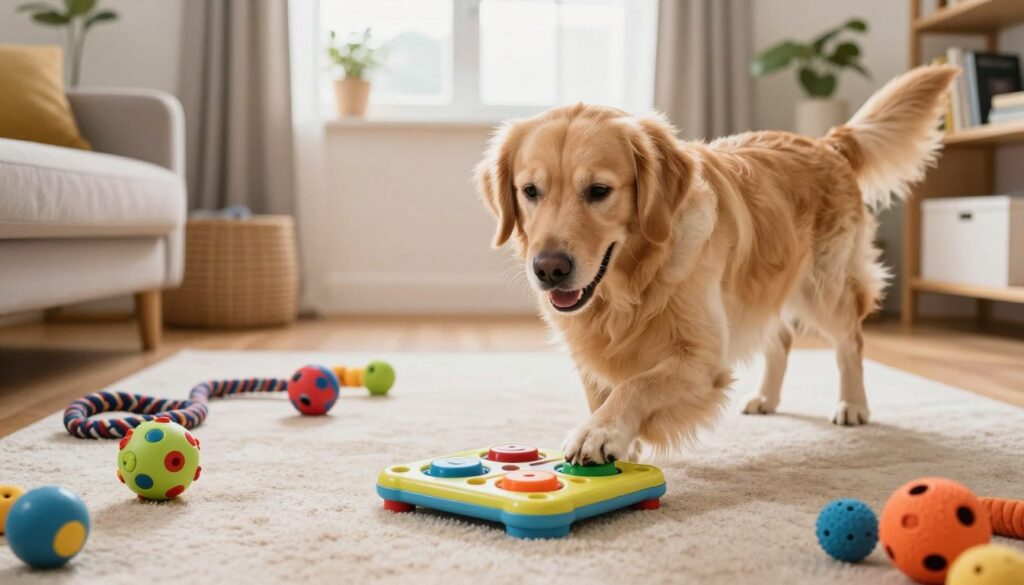
Mental challenges can be seamlessly integrated into your dog’s daily routines, making mealtime and walks more engaging. For example, using interactive feeders during meals or practicing obedience commands during walks can turn ordinary activities into mentally stimulating experiences.
Tips for mealtime enrichment:
- Use interactive feeders that challenge your dog to work for their food.
- Hide treats or kibble around the house or yard for your dog to find.
- Practice “wait” or “stay” commands before meals to build patience and self-control.
By incorporating these strategies into your dog’s daily life, you can provide them with the mental stimulation they need to thrive. A mentally active dog is not only happier but also a more enjoyable companion.
Conclusion: A Mentally Stimulated Dog is a Happier, Healthier Companion
Keeping your dog mentally active is crucial for their overall happiness and health. Through various indoor games and activities, you can provide your dog with the mental stimulation they need to prevent boredom, stress, and behavioral problems.
Engaging your dog in mental stimulation activities such as puzzle games, scent work, and training exercises can challenge their minds and keep them engaged. These brain games for dogs not only provide entertainment but also strengthen your bond with your pet.
By incorporating these activities into your daily routine, you can ensure your dog remains dog mentally active and stimulated. This, in turn, can lead to a happier, healthier companion. Rotating toys and games, creating a weekly mental enrichment schedule, and incorporating mental challenges into daily routines can keep your dog engaged and stimulated.
With a little creativity, you can turn your home into a playground that fosters mental agility and happiness for your dog. Start exploring these indoor games and activities today to give your dog the gift of mental stimulation and a healthier, happier life.